<!-- wp:code --> <pre class="wp-block-code"><code>You watch baggage handlers tossing suitcases, and you worry. Your new luggage could easily be cracked or broken. Can a simple strap really make a difference against that kind of treatment?
Luggage straps primarily prevent your suitcase from accidentally bursting open if the zipper or latch fails under pressure. They are not designed to stop dents, cracks, or scratches from impact. Their main job is reinforcement of the closure, not shielding the entire case.
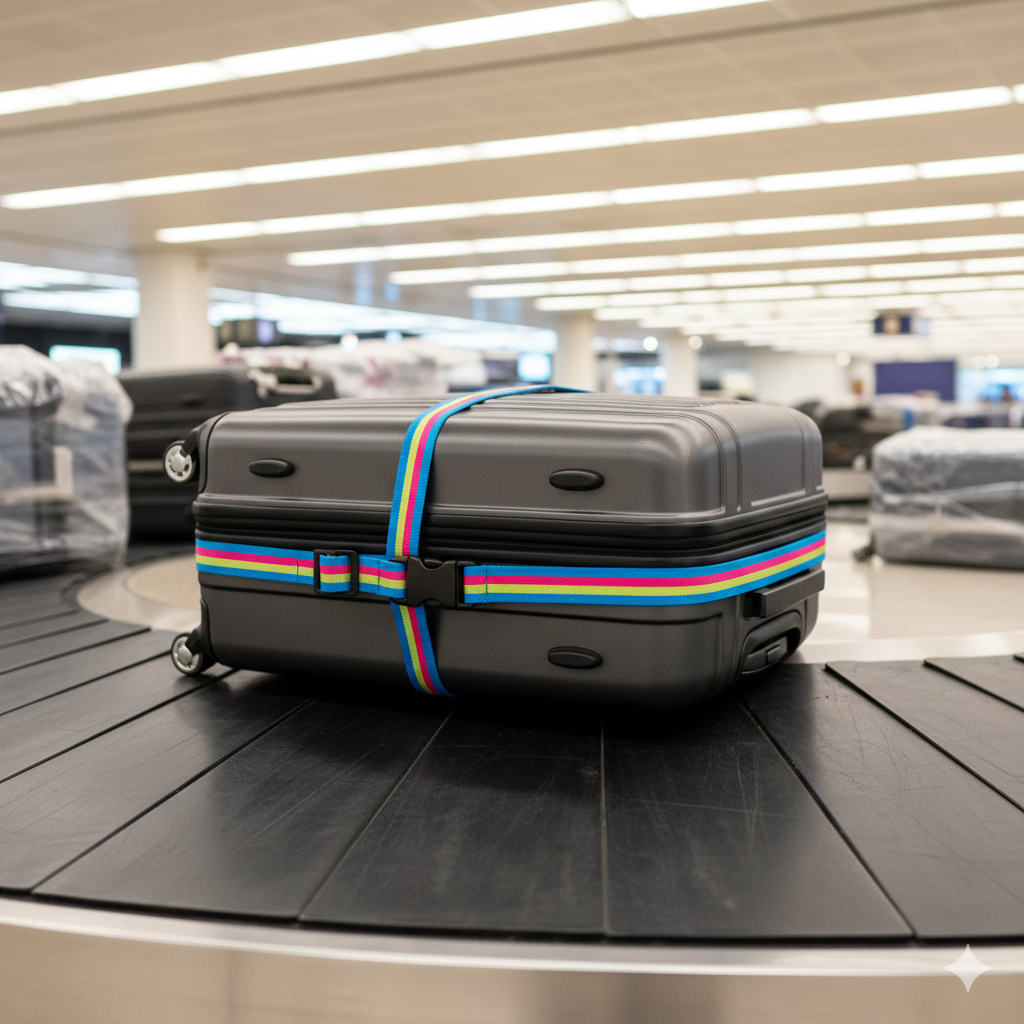
As a product designer, I spend my days thinking about materials, stress points, and failure modes. It doesn't matter if it's a dog harness or a travel accessory; the principles of good design are the same. A luggage strap is a perfect case study in understanding a product's true purpose versus its perceived one. It's not a suit of armor for your bag, but it is a critical safety belt.
How Do Luggage Straps Really Protect Your Suitcase?
You've invested in a good suitcase, but you've seen zippers fail. The last thing you want is for your personal belongings to be scattered across the airport tarmac or carousel.
A luggage strap acts as an external reinforcement system. It adds compressive force to keep the two halves of your suitcase held tightly together. This takes a significant amount of stress off the zippers, especially when the bag is overpacked or gets squeezed during transit.

Think of it from an engineering perspective. A suitcase zipper is the weakest point of the closure system. When the bag is dropped or compressed, all that internal force pushes outward directly on the zipper teeth. Eventually, those teeth can separate. The luggage strap works by creating a high-tensile band around the entire case. This band absorbs a huge portion of that bursting pressure. It’s not meant to stop a hard-shell case from cracking if it takes a direct, sharp impact. That job belongs to the case material, like polycarbonate. Instead, the strap's function is to maintain the structural integrity of the closure. In my work designing dog harnesses, we test the webbing for tensile strength. A luggage strap is the same concept. It's a simple, brilliant solution for preventing catastrophic zipper failure.
| Type of Damage | Suitcase Material's Role | Luggage Strap's Role |
|---|---|---|
| Bursting Open | Resists some pressure | Excellent - Directly reinforces the closure |
| Dents & Cracks | Primary Defense | None - Offers no impact absorption |
| Scratches & Scuffs | Surface durability | Minimal - Only protects the area it covers |
Can a Luggage Strap Do More Than Just Hold Things Together?
You're at the baggage claim, staring at a sea of identical black suitcases. Every time one comes around, you have to read the tag, creating stress and delay. Isn't there an easier way?
Absolutely. A luggage strap’s secondary function is just as important as its first. A brightly colored or uniquely patterned strap makes your bag instantly visible and identifiable on a crowded carousel, saving you time and preventing someone from accidentally taking your bag.

In product design, we always look for secondary benefits that add value. The visibility of a luggage strap is a massive value-add. It solves a huge pain point for travelers. Beyond just making your bag easy to spot, it also acts as a minor security deterrent. A thief looking for a quick, anonymous bag to grab will likely skip the one with a distinctive, attention-grabbing strap. Some straps even come with integrated TSA-approved locks. While a simple lock won't stop a determined criminal, it will stop an opportunistic one from quickly unzipping your bag. This is exactly like when we add a strip of reflective 3M material to a dog leash. The leash's primary job is control, but its secondary job—making you visible to cars at night—is a critical safety feature. The visibility of your luggage strap is a safety feature for your possessions. It’s a simple, low-cost way to add both identification and a layer of security.
What Makes a Good Luggage Strap From a Design Perspective?
You see flimsy straps for sale everywhere, with thin webbing and cheap plastic buckles. You know intuitively that a bad strap is worse than no strap at all. What should you look for?
A well-designed luggage strap is made from thick, tightly woven nylon or polypropylene webbing for high tensile strength. It should have a robust, heavy-duty buckle made from a material like POM (polyoxymethylene) and strong, reinforced stitching (like a box stitch) at all stress points.

When I evaluate a product, I break it down into its core components. For a luggage strap, there are two: the webbing and the buckle.
The Webbing
The material matters. Nylon is extremely strong and has a little bit of stretch, which can help absorb shock. Polypropylene is also strong, lighter, and resists water. More important than the material is the weave. A dense, thick weave is a clear sign of quality. A wider strap (2 inches is good) distributes pressure more effectively than a narrow one.
The Buckle
This is the most common failure point. A cheap buckle made from brittle ABS plastic can shatter under the pressure of a baggage system. Look for buckles made from stronger polymers like POM, which is known for its stiffness and stability. The design of the buckle itself is also key. A good side-release buckle will have thick prongs that engage securely with a solid "click."
The construction that joins these two parts must be solid. Look for heavy-duty thread used in a box stitch or X-pattern, which provides far more reinforcement than a simple straight line of stitches. It's the exact same standard we demand for the buckles and D-rings on our dog harnesses, where failure is not an option.
Conclusion
A quality luggage strap is a smart investment. It won't make your bag indestructible, but it will prevent it from bursting open while making it easy to identify and a little more secure.</code></pre> <!-- /wp:code -->